
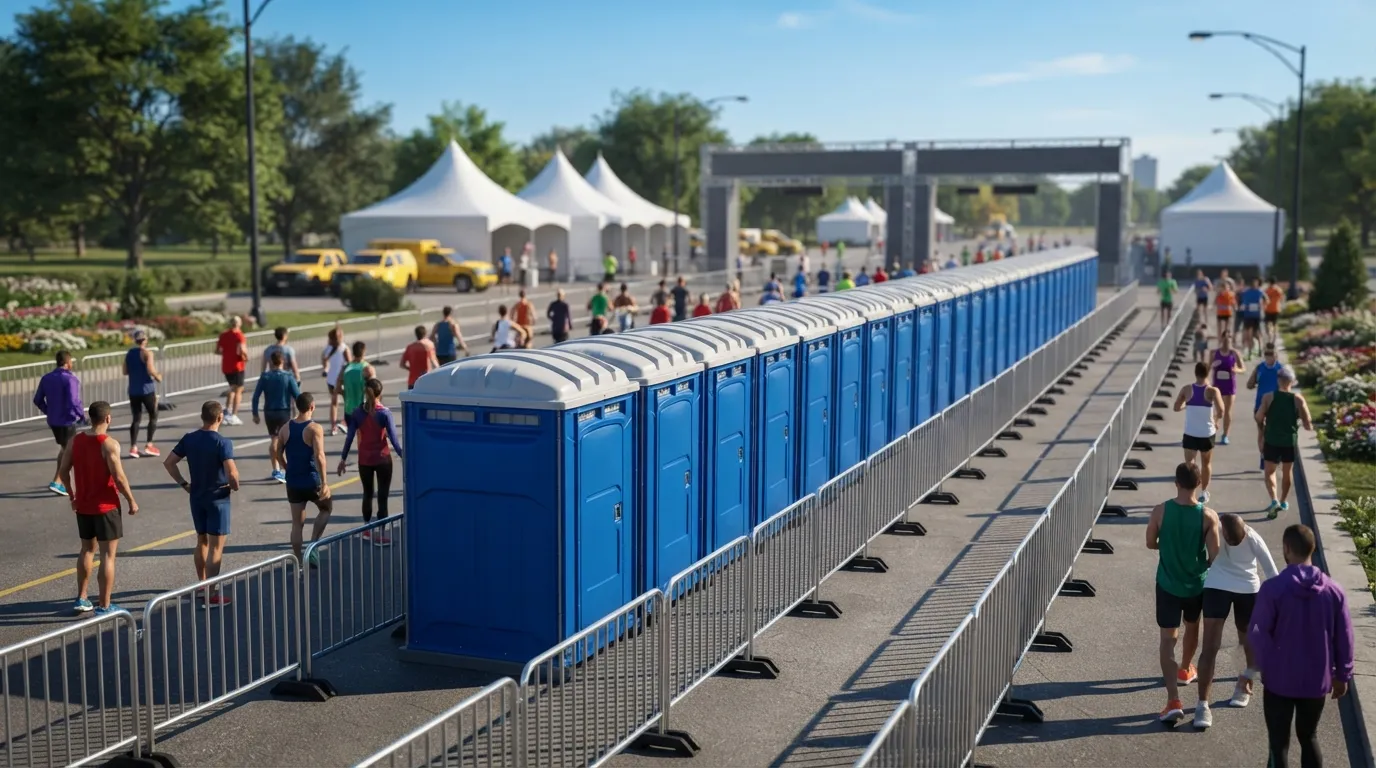
How many restrooms does a race need?
Start with runner count, then split it across the start line, the finish chute and any aid stations along the route. OSHA 1926.51(c) sets construction ratios, not race-day standards, but race organizers around Cincinnati use similar per-person math to avoid long lines at the gun. A cluster of 10 to 15 standard porta potties at a start line for 2,000 runners is a common baseline, with smaller groups of 2 to 4 units placed every mile or two along longer courses. Bigger races add a few deluxe flushable units near VIP or sponsor tents. Every cluster needs at least one accessible unit under ADA Standards section 213.2, which requires 5 percent of clustered single-user toilets to be accessible with never fewer than one. If your race finishes near a venue with existing facilities, factor that into the count rather than doubling up. Need a rough number before you call? Our porta potty calculator guide walks through the same math dispatch uses when scoping a course. For a full read on federal rules that inform these placements, see OSHA portable toilet requirements.
Where should restrooms go on a race course?
Placement matters more than raw count. Units belong on firm, level ground, off the running surface but close enough that runners do not lose time detouring. ADA Standards section 405.2 caps ramp slope at 1:12, so any unit serving a wheelchair racer needs a stable approach, not a grass slope. ADA Standards section 302.1 also calls for stable, firm, slip-resistant ground, which rules out soft turf after rain. Aid stations near mile markers should pair a restroom cluster with a handwashing station rental or a portable sink rental, especially if the aid station is handing out gels or fueling products. If your course runs through Cincinnati and touches a suburb, check our service areas page for placement near Norwood, 5.4 miles northeast, or Fort Thomas, 7.9 miles southeast, since courses that cross jurisdiction lines sometimes need coordination with more than one city department. A roll-off delivery truck needs about 60 feet of straight clearance behind it, which matters if you are also staging a roll-off dumpster for course cleanup near a finish-line festival.
If your race includes generator-powered timing equipment or lighting near a start corral, bracing matters as much as placement. Crews setting a temporary power pole for scoreboards or PA systems should anchor the base plate, guy the pole at two points minimum, and keep the run clear of the restroom cluster and any pedestrian chute. A poorly braced pole near a crowded start line is a hazard multiplier, not just an inconvenience. Knowing how to brace a temporary power pole properly, base plate anchored, two guy points minimum, run kept clear of foot traffic, is the difference between a stable rig and a call to the medic tent. Pair that setup with our temporary power pole page if your race needs power beyond what a generator on a trailer can handle.

Do race restrooms need to be serviced during the event?
Yes, for anything beyond a half-day race. ANSI/PSAI Z4.3 sets a baseline service interval of once weekly for up to 10 users over a 40 hour week, but race-day usage compresses that math into a few hours, so units get serviced before the gun, not mid-race. A marathon with an early start and a midday finish rarely needs a second service, but multi-day events like a county fair alongside a race weekend do. If your race is part of a larger weekend event, see festival restroom rental or county fair restrooms for combined planning. Standard units run $125 to $400 for a weekend rate in prose terms, and organizers often pair units with a restroom trailer rental for VIP or sponsor areas needing a nicer finish. A 60 to 70 gallon holding tank on a standard unit handles a full day of race traffic without needing a mid-event pump-out, assuming the cluster count matches your runner load. For races anchored in Cincinnati proper, delivery and pickup timing around road closures is the main scheduling variable, not tank capacity.
| unit | duration | typical price |
|---|---|---|
| standard | event | $400 |
| ada | weekend | $240 |
| deluxe | week | $250 |
| trailer | event | $3,500 |
Prices above sit within measured ranges; request a quote for your specific course length and runner count through request a quote.
How far in advance should I book race restrooms?
Book as soon as your course map and runner count are set, ideally 60 to 90 days out for larger races. Permitting, road closures and unit availability all tighten closer to race day. Smaller local races in Cincinnati can often book with less lead time; check emergency porta potty rental if your timeline is tight.
Can I place restrooms in the public right of way for a start line?
That depends on the city department managing your road closure permit, and it needs confirming case by case. Cincinnati Porta Pros coordinates placement with your race director, but the property or right-of-way approval itself comes from the permitting city.
What is the difference between standard and deluxe units for a race?
Standard units are the workhorse option for course-side placement, while deluxe flushable units add a nicer interior finish for VIP tents or sponsor villages. See deluxe flushable porta potty for specs and pricing context.
Do I need an ADA unit even for a small local race?
Yes, if you are clustering units at all. ADA Standards section 213.2 requires at least one accessible unit per cluster, regardless of cluster size, so even a 5K start line needs one.
Can restrooms be moved mid-race for a rolling road closure?
Not typically once placed, since units need level, stable ground per ADA Standards section 302.1. Plan fixed placements at start, finish and aid stations rather than counting on mid-event relocation.
Next step
Get a delivery date
Tell us the address, the dates and the headcount. We size the order and confirm the route.