
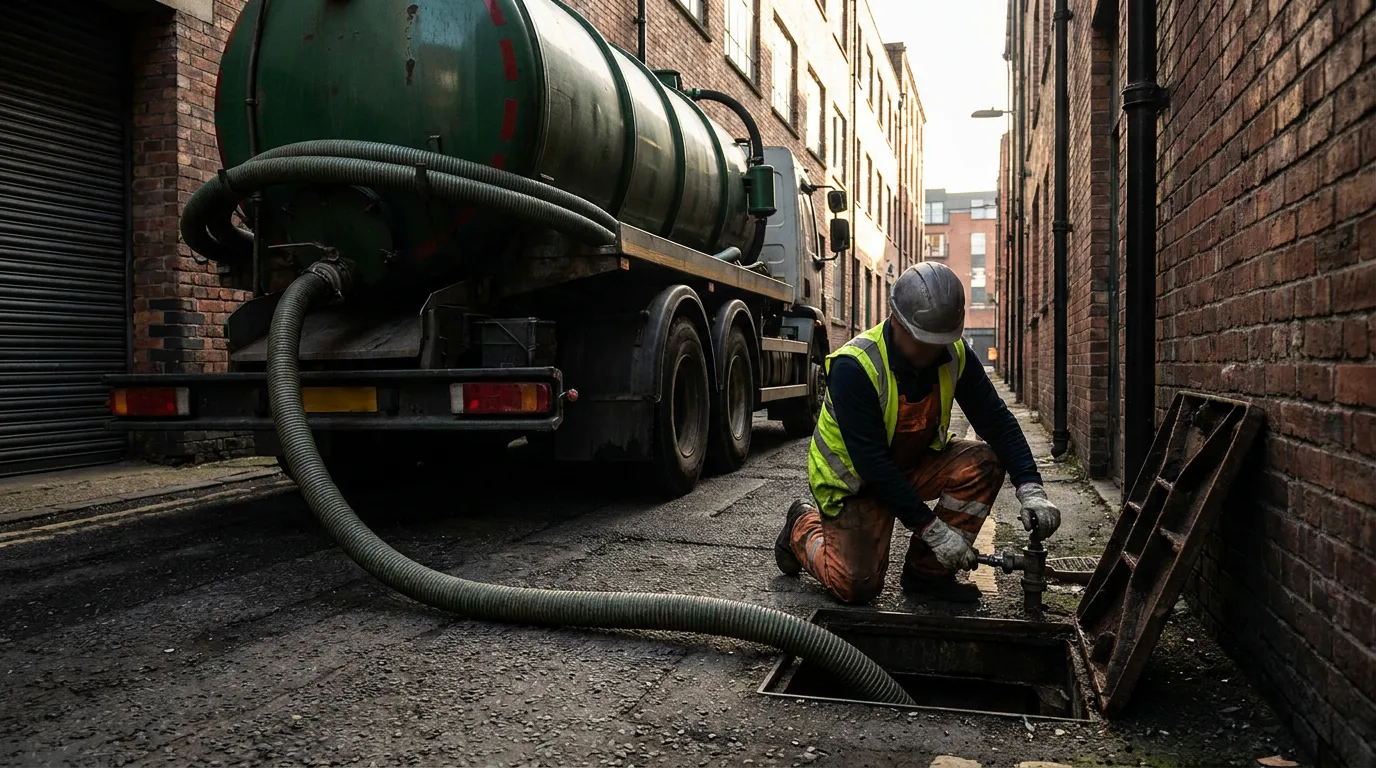
How Often Does a Septic Tank Need Cleaning?
Three to five years is the standard window for a household septic tank, and that range comes from tank size measured against how many people are using it daily. A family of five in a 1,000 gallon tank fills solids faster than a couple in the same tank, so the low end of that range fits bigger households, which is also why our how often to pump a septic tank guidance always starts with a headcount. Garbage disposals, long showers and laundry all speed up the clock too. If you are unsure where your property lands, septic tank pumping cost in Cincinnati varies with tank access and how much sludge has built up, so a first inspection is worth scheduling before you guess. Homes near Norwood, about 5.4 miles northeast of downtown Cincinnati, often share similar soil conditions that affect drain field performance. If you are building new construction and need interim sanitation while a system gets installed, look at construction site services or a holding tank rental to bridge the gap. Waiting too long between pumpings lets solids reach the outlet pipe, which is the fastest way to force an emergency septic service call instead of a routine one.
What Happens If You Wait Too Long Between Pumpings?
Solids build up until they escape into the drain field, and once that happens the fix is a lot more than a pump-out. A septic tank works by settling solids at the bottom while liquid flows out to the drain field; when the solid layer gets too thick, untreated waste starts moving into pipes that were never built to filter it. That is expensive to repair and sometimes means replacing the field entirely, and it is the same kind of overflow risk covered on our septic tank warning signs page. Watch for septic tank warning signs like slow drains, gurgling pipes or standing water in the yard. Restaurants and commercial kitchens face a related but different clock: a grease interceptor gets pumped once fats, oils, grease and solids reach 25 percent of the liquid depth, which can happen well before a residential timeline applies. If you run a kitchen in Cincinnati or nearby Fort Thomas, about 7.9 miles southeast, ask about grease trap pumping on its own schedule, separate from your home system.

Do Household Size and Tank Size Change the Schedule?
Yes, both matter more than the calendar date on your last pump-out receipt. A larger tank buys you more time between services, while more people in the house shortens it, and the 3 to 5 year range exists precisely because those two variables pull against each other. For a broader look at scheduling, our septic pumping service page covers intervals city-wide. Here is roughly how the pieces line up:
| Factor | Effect on interval |
|---|---|
| Larger tank size | Longer interval |
| More residents | Shorter interval |
| Garbage disposal use | Shorter interval |
| High water usage (laundry, long showers) | Shorter interval |
| Older or undersized tank | Shorter interval |
If you are renovating a Cincinnati home and the septic system is offline during work, a septic pumping service can handle interim needs, and a home renovation porta potty keeps the crew covered while plumbing is disconnected. For larger properties or farms, farm and agricultural restrooms and septic pumping often get scheduled together on the same visit to save a trip, and event sites sometimes add a portable restroom rental or porta potty rental order to the same delivery run.
Why Does Soil and Location Affect Pumping Frequency?
Soil drainage speed changes how hard your drain field works, and that feeds back into how often the tank itself needs attention. Slow-draining clay soil, common across parts of greater Cincinnati, keeps the drain field wetter longer, which can push solids back toward the tank outlet sooner than in sandy soil. Properties near Covington, 11.2 miles south, or Independence, 16.9 miles south, sometimes deal with similar drainage patterns depending on lot grading, similar to what we see on jobs out toward Florence, porta potty rental in Florence, KY, and Hamilton, porta potty rental in Hamilton, OH. None of this is a fixed rule, which is why an inspection beats a guess. Septic tank cleaning crews can check sludge depth directly and tell you if your actual interval runs shorter than the standard 3 to 5 year window. If you are weighing a full system replacement against ongoing pumping, that inspection data is what makes the decision instead of a rule of thumb, much like checking septic tank pumping cost before you commit to either option.
How do I know my septic tank needs pumping now?
Slow drains, gurgling toilets, sewage odor near the drain field or standing water in the yard are the clearest signs. Check the full list of septic tank warning signs if any of that sounds familiar. Do not wait for a backup. A same-day emergency septic service call is cheaper than a flooded basement or a failed drain field.
Does household size really change the interval that much?
Yes. A tank sized for four people, used by seven, fills faster and may need pumping closer to every 3 years instead of 5. Garbage disposals and heavy laundry use add to that load. When in doubt, get the tank measured, and see how often to pump a septic tank for the general rule before you call.
Can I schedule septic pumping with other site services?
Often, yes. Crews doing septic tank cleaning can sometimes combine a visit with dumpster drop-off or portable restroom delivery on active renovation or construction sites, which saves a trip charge for both services, especially on sites that also need a roll-off dumpster rental or a storage container rental for the same project.
What is the difference between a septic tank and a grease trap?
A septic tank handles household wastewater and is pumped every 3 to 5 years. A grease trap serves commercial kitchens and gets pumped once fats, oils and grease reach 25 percent of liquid depth, often far more frequently. See grease trap pumping for details.
Is septic pumping frequency different for rural Cincinnati properties?
Not fundamentally. The same 3 to 5 year range applies, but well water use, larger lots and older tanks common on rural properties can shift the real number. An inspection settles it faster than an estimate based on address alone, whether the property sits near our service areas hub or out past Mason, porta potty rental in Mason, OH.
Next step
Get a delivery date
Tell us the address, the dates and the headcount. We size the order and confirm the route.